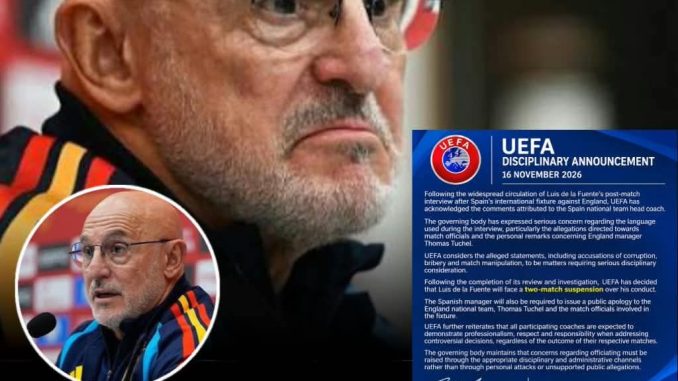
Football fans have been reacting after UEFA delivered a major disciplinary decision following England’s dramatic 3-2 victory over Spain in Madrid, a match that has continued to generate controversy long after the final whistle.
What was expected to be a battle between two of Europe’s strongest national teams quickly became much more than a football match. From the heated exchange involving England manager Thomas Tuchel and Spain boss Luis de la Fuente before kick-off to the controversial incidents during the game and the disciplinary consequences that followed, the encounter has provided plenty of talking points.
However, the latest development has added another unexpected chapter to an already explosive international football story.
UEFA has officially sanctioned the English Football Association following discriminatory chanting by some England supporters during the Nations League encounter at the Riyadh Air Metropolitano on November 15.
The governing body imposed a €15,000 fine on the FA and ordered a one-match restriction on selling away tickets to England supporters. The restriction has been suspended for a probationary period of two years, meaning it will only take effect if another qualifying offence occurs during that period.
The decision has attracted attention because of the controversy surrounding the match, particularly the disagreement between Tuchel and De la Fuente over racism and the responsibilities of football authorities in dealing with discriminatory behaviour.
Although the UEFA punishment was directed at the English FA and not De la Fuente personally, the decision has brought the wider controversy back into the spotlight.
THE TUCHEL AND DE LA FUENTE ROW THAT SET THE STAGE
The tension between the two managers began before a ball was kicked in Madrid.
Ahead of the Nations League showdown, Tuchel was asked how England would respond if their players were subjected to racist abuse during the match.
The question was particularly sensitive because England’s previous visit to the Spanish capital in 2004 had been overshadowed by racist chanting directed at several Black England players.
Tuchel explained that he would remind his players about UEFA’s anti-racism procedures before the match.
The England manager made it clear that he did not expect any racist incidents, but believed his squad needed to understand the procedures available if such behaviour occurred.
His comments were intended to address a hypothetical situation and ensure that the players understood how to respond.
However, the remarks quickly became a major talking point in the Spanish media.
De la Fuente was subsequently asked whether Tuchel’s comments suggested that Spanish football still had work to do in tackling racism.
The Spain manager responded strongly.
“What I can tell you, and you can pass this on to Thomas, is that in Spain, there’s no racism. That’s how strongly I feel about it.”
He continued by insisting that Spain should not be portrayed as a country where racism was an accepted part of football culture.
“Just as in England, there’s no racism in Spain. None of us are racist.”
His response immediately attracted attention, particularly because Spain had recently faced UEFA disciplinary action following discriminatory chanting by supporters during a match against Egypt.
The comments also raised questions about whether the two managers were interpreting the original discussion in the same way.
Tuchel was subsequently informed about De la Fuente’s response and made it clear that he was unhappy with how his original comments had been presented.
The German manager insisted that he had never accused Spain of being a racist country.
He criticised the way the conversation had developed, accusing sections of the media of creating unnecessary confusion.
“I never talked about racism in Spain. I answered politely a question about what happens,” Tuchel explained.
The England boss added that he expected a friendly atmosphere in Madrid and believed football should bring people together rather than create division.
What began as a discussion about anti-racism procedures had therefore developed into one of the biggest talking points ahead of the encounter.
ENGLAND DELIVER A STATEMENT WITH A DRAMATIC 3-2 VICTORY
While the managers’ disagreement dominated the pre-match headlines, England made sure the football itself would provide another major talking point.
Thomas Tuchel’s side travelled to Madrid knowing that victory would secure top spot in their UEFA Nations League group.
However, few could have predicted the dramatic manner in which the Three Lions would eventually get the job done.
England produced an outstanding attacking performance and established a commanding three-goal advantage against the Spanish side.
Harry Kane opened the scoring from the penalty spot shortly before half-time after being fouled by Pau Cubarsí.
The England captain calmly converted the opportunity to give the visitors a valuable advantage heading into the break.
Spain returned for the second half hoping to respond, but England immediately increased the pressure.
Ezri Konsa doubled the lead in the 53rd minute, heading home from a Declan Rice corner after finding himself unmarked inside the penalty area.
Just four minutes later, Ben White delivered another devastating blow.
The Arsenal defender finished a flowing England attacking move to make it 3-0, leaving the Spanish supporters inside the stadium stunned.
At that stage, England appeared to be heading towards a comfortable victory.
However, the match was far from over.
The turning point arrived when Elliot Anderson was sent off for pulling back Lamine Yamal as the Spanish forward threatened to break through on goal.
The referee awarded Spain a penalty and showed Anderson a red card for denying a clear goalscoring opportunity.
Mikel Oyarzabal converted the resulting penalty in the 65th minute, giving the home side renewed hope.
Spain immediately increased the pressure and began taking advantage of their numerical superiority.
Nico Williams pulled another goal back in the 75th minute after a dangerous attacking move involving Yamal.
Suddenly, England’s comfortable three-goal advantage had been reduced to just one.
The final stages became increasingly tense as Spain searched desperately for an equaliser.
James Trafford produced important saves to deny the hosts, including a remarkable double intervention in stoppage time that helped England protect their advantage.
When the final whistle arrived, England had secured a memorable 3-2 victory.
The result ended Spain’s 43-match unbeaten run and confirmed England’s position at the top of UEFA Nations League Group A3.
It was a significant result for Tuchel, whose team had demonstrated resilience, attacking quality and determination against the reigning European champions.
UEFA’S DISCIPLINARY DECISION BRINGS ANOTHER TWIST
Just when the attention surrounding the match appeared to be settling, UEFA announced its disciplinary decision.
The governing body’s Control, Ethics and Disciplinary Body reviewed incidents from several Nations League fixtures, including the encounter between Spain and England.
In its official decision concerning the Madrid match, UEFA charged the English Football Association with racist and/or discriminatory behaviour under Article 14(2) of its Disciplinary Regulations.
The punishment was a €15,000 fine and a one-match restriction on selling tickets to England supporters for an away fixture in a UEFA national-team competition.
However, the ticket restriction was suspended for two years.
This means England supporters will not immediately be prevented from travelling to support their national team in away fixtures. The suspended restriction would only be activated if another qualifying offence occurs during the probationary period.
According to reports from Sky Sports and BBC Sport, the disciplinary action concerned anti-Catholic and anti-Irish chanting by sections of England’s travelling support.
The decision was particularly significant because of the discussions about racism and discrimination that had dominated the build-up to the match.
There had been considerable attention on the possibility of discriminatory incidents involving Spanish supporters, given the history between the two countries.
Instead, UEFA’s disciplinary decision following the match concerned the behaviour of some England supporters.
It was an uncomfortable development for the Football Association, especially after the organisation had been involved in discussions about preventing discrimination and ensuring a respectful atmosphere at international matches.
The FA made its position clear, condemning the chants and promising to work with the police to identify those responsible.
The organisation stressed that such behaviour would not be tolerated and that discriminatory conduct had no place in football.
WHY THE DECISION HAS ATTRACTED SO MUCH ATTENTION
The UEFA announcement has generated discussion because it highlights an important issue that often gets lost when football rivalries become heated.
Before the match, the conversation was largely focused on England’s concerns about possible racist abuse and the response from the Spanish manager.
Tuchel wanted his players to understand the anti-racism procedures available to them.
De la Fuente, meanwhile, strongly rejected the suggestion that Spain should be associated with racism.
Both managers found themselves at the centre of a debate that attracted considerable media attention.
However, UEFA’s latest decision has demonstrated that discriminatory behaviour is not an issue that belongs to one particular country or group of supporters.
The governing body has made it clear through its disciplinary action that offensive conduct by supporters can have consequences regardless of which national team is involved.
The incident has also raised questions about collective responsibility.
While the behaviour was attributed to sections of the England support, the financial and sporting consequences have fallen on the Football Association and could eventually affect thousands of innocent supporters if the suspended restriction is activated.
This is one reason the FA has indicated that it intends to work with law enforcement agencies to identify those responsible.
The intention is to ensure that individuals involved in unacceptable behaviour are held accountable rather than allowing the situation to damage the experience of other travelling supporters.
DE LA FUENTE AND TUCHEL BACK IN THE SPOTLIGHT
Despite the UEFA ruling not being directed at De la Fuente, the Spanish manager remains closely associated with the controversy surrounding the match.
His comments before kick-off attracted considerable attention, particularly his insistence that racism did not exist in Spain.
Tuchel’s response also became a major talking point, with the England manager expressing frustration at the way his original remarks had been interpreted.
The subsequent match added even more drama, with England taking a three-goal lead before Spain nearly completed an incredible comeback.
The two managers therefore found themselves involved in a story that extended beyond tactics, team selection and the final score.
For Tuchel, the victory was an important statement about England’s progress and ability to compete against Europe’s strongest sides.
For De la Fuente, the defeat was a painful end to Spain’s remarkable unbeaten run.
The disciplinary announcement has now brought renewed attention to the wider issues surrounding the encounter.
However, there is no confirmed UEFA disciplinary sanction against De la Fuente personally over his comments, nor has UEFA announced a punishment against him for criticising the match officials.
The confirmed disciplinary action relates to the English FA and the conduct of supporters.
FANS REACT AS THE CONTROVERSY CONTINUES
As news of UEFA’s decision spread, the England-Spain encounter once again became a major talking point among football supporters.
The match had already delivered everything that makes international football so unpredictable: heated pre-match exchanges, three England goals, a controversial red card, a dramatic Spanish comeback and a tense finish.
The disciplinary announcement has provided another reason for supporters to revisit the contest.
For some, the decision is a reminder that football authorities must apply their rules consistently and take discriminatory behaviour seriously, regardless of the identity of the supporters involved.
Others are likely to focus on the fact that the suspended away-ticket restriction could affect England fans who had nothing to do with the incident.
Nevertheless, the Football Association has made clear that it does not intend to ignore the matter.
The wider message from UEFA is that football should not become a platform for discrimination, abuse or behaviour that undermines the values of the sport.
THE STORY IS FAR FROM OVER
The England-Spain encounter will be remembered for much more than its 3-2 scoreline.
It was a match that brought together sporting excellence, managerial tension, controversial moments and an important disciplinary issue.
England secured a memorable victory, ended Spain’s 43-match unbeaten run and finished top of their Nations League group.
But the events surrounding the game have continued to generate headlines.
UEFA’s €15,000 fine and suspended away-ticket restriction have now added another dimension to the story, while the disagreement between Tuchel and De la Fuente remains one of the most memorable talking points from the build-up.
One thing is certain: the encounter in Madrid has provided a powerful reminder that the responsibilities of football managers, players, supporters and governing bodies extend far beyond what happens on the pitch.
And with UEFA making its position clear through its disciplinary decision, the spotlight is firmly back on the behaviour of supporters and the importance of protecting football from discrimination.
For England, the victory remains a major sporting achievement. For the FA, however, the disciplinary decision is a warning that the behaviour of a section of supporters can overshadow even the biggest results.
Be the first to comment